Thursday, September 17, 2015

Palindromes

When students would rather stay in class and work on a math investigation than go to P.E., you know they are excited about math!  I couldn't be more thrilled with the way our palindrome investigation has gone over the past three days.

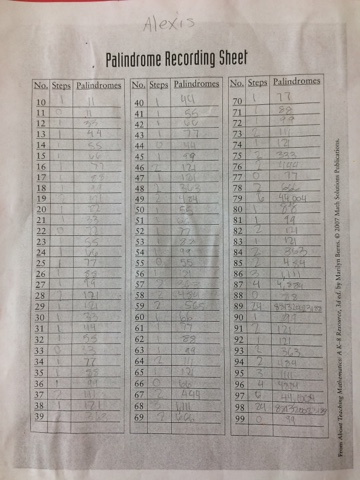
On Tuesday, I introduced the students to the concept of palindromes (words, phrases or numbers that are the same forward and backward, ex: wow, Hannah, race car, 303, 99).  I told them that there were palindromes in numbers, but not all numbers started as palindromes.  For instance, 13 is not a palindrome.  However, if you add the reverse of it, 13 + 31, you get 44, a palindrome.  We called this a "1-step" palindrome.  Some numbers take more steps, like 39.  39 + 93 = 132.  132 + 231 = 363, so 39 is a "2-step" palindrome.

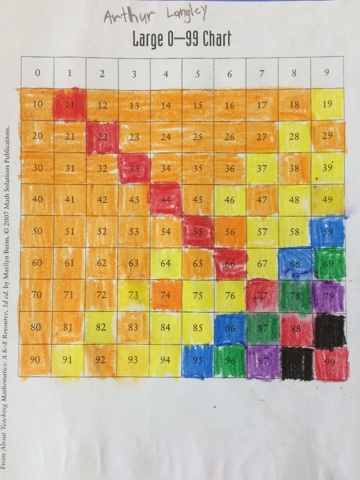
The students quickly dove into the investigation eager to find patterns in numbers 10 - 99.  They worked as groups dividing up the work and quickly noticed patterns in palindromes and the number of steps.  To show these patterns, we color-coded our 0-99 chart so that 0-step palindromes were red, 1-step were orange, 2-step were yellow and so on.

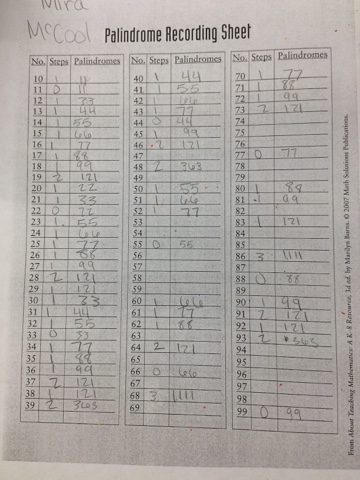
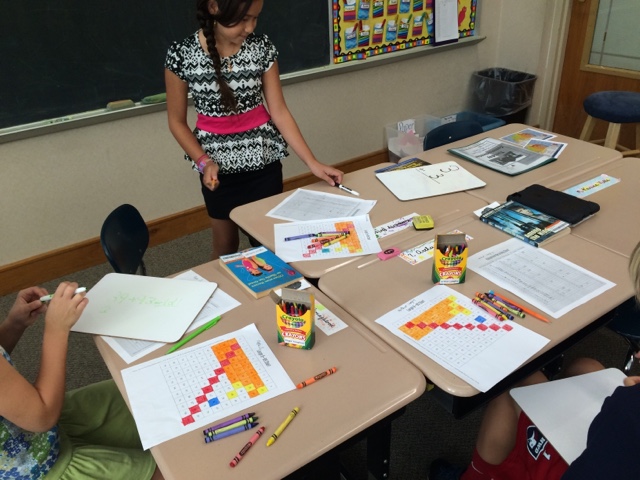


Students worked eagerly, enthusiastically and cooperatively to complete the task.  Sure, the only "math skill" they were working on was addition, but as far as the mathematical practices go, those eight standards we expect all students to show when solving math problems, well, they showed practically every one. They solved problems without giving up (just ask them about 89 and 98); they thought about numbers in many different ways; they defended their thinking to one another; they used math tools such as a chart and a calculator (only for 89 and 98); they worked carefully and checked their work; they used what they knew to solve new problems and they looked for patterns.

I am so proud of these students for their hard work, perseverance, and for their attitude as they investigated numbers.
Monday, September 14, 2015

Drop Challenge

Today we began our study of sound in science.  We started the unit by listening to items drop and describing the sounds that they made.  Students used sound discrimination to discern what item was dropped into the "drop chamber" and tried to guess the correct object.


Sunday, September 13, 2015

First Nine Weeks, Week 6

Reading: We are continuing to work on decoding skills as well as reading signposts.  Our focus this week will be theme as we discuss the signpost "Words of the Wiser."

Language: We are finishing up cursive letters, which means students should be writing more and more in cursive.  Challenge your child to write in cursive at home whenever possible.  We will also working on singular and plural possessives (students' vs student's).

Math: The students are enjoying the addition and subtraction menu.  We have been talking about different strategies for addition and will soon be discussing strategies for subtraction.  We will also be investigating palindromes (numbers and words that are the same forward and backward) as we learn about how there are patterns everywhere in numbers!

Alabama History: We are continuing our focus on Alabama geography.  This week we will continue to discuss Alabama's five main regions as well as Alabama's climate and natural resources.

Science: Our study of sound begins this week!  Students will be investigating sound discrimination as they learn about different properties of sound.

Tuesday, September 8, 2015

Light

Over the last few weeks, students have been experimenting with light.  Students have used flashlights and different objects in the classroom to learn more about transparent, translucent and opaque materials.  Students have also investigated how light is bent when entering a different type of material.  Check out this experiment where a penny is stuck to the bottom of the bowl.  The camera remains in the same location, but as more water is poured into the bowl, what happens to the penny?  Why?  Ask a 4th grader!  Or, try it yourself and see what you can determine!


Monday, September 7, 2015

First Nine Weeks, Week 5

Reading: Students are continuing to learn decoding rules to help them read unknown words they come across in their reading.  We will be examining another signpost this week called "Again and Again."  Students will be on the lookout for authors that keep mentioned the same word or phrase repeatedly.  As they notice this repetition, they'll use that to help them make inferences about the characters in the story as well as the plot.

Language:  We are nearing our review of cursive letters.  Soon, students will be required to do all of their work in cursive.  A few minutes of practice each night is always a great idea!  Our focus on nouns continues as we examine pronouns this week.

Math:  We will do a bit more work on rounding this week before completing our Place Value Menu.  Later in the week, our focus will shift to using place value knowledge to solve addition problems using a variety of strategies.

Science: We will review for a test on light that the students will take on Friday.  Students should be able to fully explain what opaque, translucent and transparent mean as well as give examples of objects that fit into each category.  They may use Study Stack to help them study.

Alabama History:  There will be more focus on the regions in Alabama this week as we look more closely at the counties of Alabama as well as how to read a map of Alabama.

Chrome Book Friday

This summer, the PTO generously purchased a Chrome Book cart for the fourth grade.  What is a Chrome Book?  Well, it is basically a laptop that has no hard drive, meaning it is only for connecting to the internet.  But, since all PowerPoint type presentations and all typed papers are done on Google Drive now, they are perfect!  This now means that 4th grade has a laptop cart and a Chrome Book cart.  As a grade level, we decided to each have the Chrome Book cart for a day and then share the laptops whenever we needed them.  Our day for Chrome Books is Friday.  Does this mean we will use them all day?  No, of course not.  Does this mean that's the only day of the week we'll use them?  Well, sort of, but we'll be using the laptop cart other days of the week.

This past Friday, we put them to good use!  The students started our math lesson by playing online games that worked on rounding numbers.


Then, in the afternoon, students played online games identifying common and proper nouns.


For our science lesson, students read a few pages in our textbook with a partner or in a small group and used an online discussion board through Schoology to share interesting facts they learned about light.  


(These games and the discussion board can all be revisited on Schoology.)

We are all very thankful to the PTO for this generous contribution that helps make learning more engaging and helps students develop 21st century skills!


Rounding

Students are learning how to round numbers.  The number line is an excellent tool to help students determine how to round the given number to the nearest place value.  For example:


By using the number line, students are truly showing their understanding of numbers and how close they are to nearby landmark numbers.  Students won't always need number lines to round.  Many are already finding their own "tricks" to help them round.